When believers in Christ join together as a congregation to do the work that Jesus commissioned the church to do: How can ministry best be organized to allow the church to function and fulfill its purpose? This article is intended to present general principles that can be adapted to fit the unique character of a local church and to also give a fresh perspective on approaching ministry. These principles can be applied to the constitution or bylaws of a local church to help them stay focused on the purpose and mission of the church and help prevent them from falling into complacency and just “doing church.” In architecture, one of the most important concepts is that “form follows function.” I believe that in a similar way the form or structure of ministry in a church should follow the function and purpose of the church. We will now look at some of these concepts by starting with the head leadership of the church and working our way down.
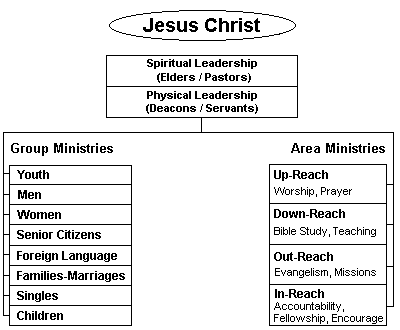
The first and most important part of the church’s structure is the Head Shepherd who is Jesus Christ (Ephesians 1:22-23, 4:15-16; 1 Corinthians 12:12-13). He is the one who joins and holds every part of the church’s body together. Without Jesus as the head of the church, it will not be able to function or accomplish its mission. Underneath the Head Shepherd, there is a group of under shepherds (overseers, elders or pastors) who are the spiritual leaders of the church. This group of spiritual leaders can be composed of some individuals who have dedicated their livelihoods to ministry and others who do not and make a living elsewhere. Their primary focus is to oversee the spiritual aspects of the church. We can see with the early church in Acts 6:1-4 that, in addition to spiritual matters, the twelve apostles also encountered other things that needed attention in the church.
Now in these days when the disciples were increasing in number, a complaint by the Hellenists arose against the Hebrews because their widows were being neglected in the daily distribution. And the twelve summoned the full number of the disciples and said, “It is not right that we should give up preaching the word of God to serve tables. Therefore, brothers, pick out from among you seven men of good repute, full of the Spirit and of wisdom, whom we will appoint to this duty. But we will devote ourselves to prayer and to the ministry of the word.” (ESV®)
This passage shows that the twelve apostles saw their need to stay focused on the spiritual matters of ministry. So they created deacons (which means “servant”) to support and serve the spiritual leadership and the church by taking care of the other primarily physical aspects of ministry. Today these things can include church finances, support staff, maintenance of the church’s property, custodial, technical ministries, and other “helps” or service ministries. This allows the spiritual leadership to not become preoccupied by these other things that need to be taken care of in the church. There is a natural tendency to get pulled into focusing on the physical world around us and end up neglecting the more important spiritual matters of the church.
With the head spiritual leadership and supporting service leadership established, we can now look at how we can structure specific areas of ministry under the head leadership. If we want to form the structure of ministry around how it functions, we need to discover the basic functions of the church. Looking at the Great Commission in Matthew 28:16-20 and at the early church in Acts 2:42-47 (and many other places in scripture), we can begin to see four basic functions or areas of ministry. These four general areas are listed in the table below:
| Evangelism, Outreach, Missions
... Matthew 28:19; 2 Corinthians 5:20; Mark 16:15 |
Fellowship, Encouraging, Accountability
... Hebrews 3:13, 10:24-25; 2 Timothy 4:2 |
| Praise, Prayer, Worship ... Ephesians 5:19-20, 6:18; Psalms 33:1 |
Equipping, Teaching, Bible Study
... Matthew 28:20; 2 Timothy 3:14-17; John 14:26 |
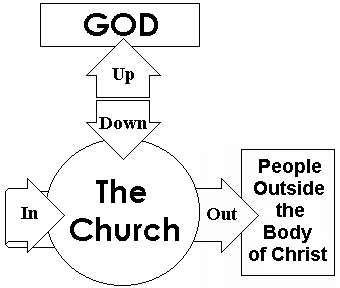
These four areas can be represented by four relationships the church has: between the church and those outside of it, the church and those within it, the church’s relationship toward God, and God’s relationship toward the church. These four relationships can be indicated by four directional words describing the direction of the relationship to the church. They are:
Out-Reach: The church reaching out to those outside the church. (Evangelism, Missions)
In-Reach: The church reaching in to those inside the church. (Encouragement, Fellowship)
Up-Reach: The church reaching up by communicating and giving to God. (Praising, Prayer, Worship)
Down-Reach: God reaching down by communicating and giving to the church. (Bible Study, Preaching, Teaching, the Holy Spirit)
All of these relationships work together in balance and are necessary for each other to function properly. These four areas are all part of the discipleship process, which is the church’s Great Commission, and is overseen by the spiritual leadership. People come into the body of Christ through evangelism and then through equipping, encouragement, and growing in their relationship with Christ they then go out and evangelize to others who are then brought into the discipleship process (Matthew 28:19-20; Romans 10:14-15). With each of these four relationships, ministry teams can be established under the church leadership to help ensure that each one functions properly and that no area is neglected or out of balance. Sub-teams can also be established under each of these four core ministry teams to deal with more specific areas if necessary. Maybe naming the ministry teams Up-Reach or In-Reach, for instance, or some other fitting name would help the team to keep focused on their purpose. The following figure illustrates the In, Out, Up and Down-Reach relationships and how each are related to one another.
It is easy to see how many ministries in the church would fit under one of those four areas. But, consider, for instance, the youth ministry of a local church. At first you might think it would just belong under the Down-Reach or equipping function of the church. But, a youth group also reaches out to unsaved youth, encourages and keeps each other accountable, and worships and prays to God at youth group meetings. This is an example of a group ministry which includes all four areas or functions of the church about as equally. There are two ways that ministries in the church can be oriented: either toward ministering to a specific area or function of the church or toward ministering to a particular people group in the church.
Group ministries are concerned with ministering in all areas of the church to a specific group of people. The groups are composed of people with a common characteristic or interest, many of which are based on age or gender. Some examples of groups could be Youth, Men, Women, Senior Citizens, Widows, Families and Marriages, Children, Singles, Foreign Language, College Students, or Single Parents. Each person in the church can be covered by more than one group, and each group can minister a little differently in each of the four areas to a particular people group. It is important with group ministries to make sure you do not create too many groups that are functioning separately by themselves. Try to keep groups that are similar together so that they will work better being with other teams that are related to it. For example, you could have a main Family ministry group with sub-teams for marriages, single parents, divorced, and grief support.
Area ministries, on the other hand, are concerned with ministering in a specific area to all groups within the church. Each of these area ministries is primarily focused on its particular function (Up, Down, In or Out) that the team deals with, but they will also include a little from the other areas as well since no area can be completely separated from the others and work effectively. In addition to each area ministry working generally with the church body as a whole, they also work with and assist each group ministry in helping them to minister in that area. For instance, an evangelism (or Out-Reach) team works with the church as a whole in evangelism efforts, as well as working with group ministries such as the Youth, Women, and Men in helping them evangelize their particular people group.
With some ministries it might be more difficult to determine whether it would be best to base the ministry under an area ministry or have it function as a group ministry. For example, if you have a ministry that is functioning primarily as a once a year outreach to a particular people group and it does not include a significant amount from other areas, such as holding bible studies or accountability groups throughout the year, it may be best to base that ministry under the Out-Reach team. Even though the ministry deals with a specific people group, it is not focused on ministering in all areas to that group. However, if over time the ministry grows to include the other areas or functions about as equally as outreach, then you could move it out from under the Out-Reach team and make it a group ministry. To help you consider which way would work best for a particular ministry, you might try thinking of a pie with four slices: one for each of the four areas or functions. If your “pie” for that ministry ends up having a single “slice” taking up almost all of the pie, it would probably work best being based under an area ministry. If your pie has all four “slices” being of about equal size, then that might be an indication that it would work best functioning as a group ministry.
Now that we have the group and area ministries established, we can look at how these ministries function internally within themselves. The leadership of each ministry can be composed of several different leadership structures depending on how large the ministry is or how much work is involved. Some ministries, particularly smaller ones, could be led by just a single leader. You could also include a co-leader to take on the responsibilities of the ministry when the leader is unavailable or to help share the work load. If a ministry is larger, and you have three or more leaders, you could make group decisions for the ministry. At the group leadership level the group can still designate a head group leader that can be given executive authority by the group to take care of certain decisions that need to be taken care of before the group is able to meet again (for example, if something breaks down and needs fixed right away). The group leader would only be able make decisions that are within the limits that the group had previously granted them. The group could also give authority in a similar manner to other group members at times to oversee details for a special project or responsibility. For some ministries, the group leader or single ministry leader could also be a staff member or pastor, such as in the case of a youth pastor or worship pastor. A ministry team leader could in some cases also act as a liaison or representative for that ministry by also being a member of the ministry team above them.
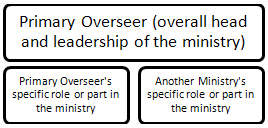
In addition to ministry teams working within their own areas and groups, there are many times when different ministry teams work together on special events or ministry efforts. In these cases, one of those ministry teams can be designated as the primary overseer for that ministry effort or event. This can usually be the ministry team that deals with the largest portion of the joint ministry or handles the primary focus of the event. This primary overseer handles how the overall ministry effort or event will look and fit together, in addition to handling their own specialized part in it. The other ministry teams involved would be responsible to the primary overseer relating to that joint ministry effort. Sometimes, with a larger joint ministry, a special ministry team made up of members of the various ministry teams involved could be established instead of designating one of the teams to be the primary overseer.
Another situation where ministry teams work together involves the support or service ministries in the church which are based as ministry teams under the head physical or service leadership. These support ministries, if they would function separately by themselves apart from the rest of the church, would not have any spiritual significance. But when they are joined together with supporting the other ministries in the church, they take on a spiritual purpose. These ministries are responsible directly to the head physical or service leadership, but are also responsible to the leadership of each ministry they support while dealing with that particular ministry. In some cases, these support ministries could just be based under a certain ministry if they primarily, or almost exclusively, deal with only that ministry. A technical ministry, for instance, could be overseen exclusively by a worship ministry if it does not deal with any other ministries in the church on a significant basis. Both the spiritual and physical focuses present in the head leadership of the church are also evident within each other ministry in the church, but usually these ministries do not have two separate groups within that ministry to focus on the spiritual and physical sides of ministry. The physical service aspects within each ministry many times work simply as a joint part of that ministry, but in cases where a service ministry also supports many other ministries in the church, they can be based under the direction of the head physical leadership of the church.
Hopefully, some of these concepts will help give you ideas as to how ministry structure might be improved in your church to help you accomplish the mission and purpose God has given the church. There are many other issues to consider in the ministry of a local church, but hopefully these concepts have helped you to look at ministry in a new perspective. Most importantly, remember to seek God in prayer, spend time in His Word, and listen to the Holy Spirit as to how He wants you to best structure ministry for your church.
Download this document in a printable PDF format.
Download this HTML document and graphics in ZIP format.
Scripture quotations are from The Holy Bible, English Standard Version® (ESV®), copyright © 2001 by Crossway, a publishing ministry of Good News Publishers. Used by permission. All rights reserved.
All other content of the Church Structure and Ministry Organization document has been released by the author, Seth Honeycutt, into the Public Domain.